Lemurs
Lemurs live on the island of Madagascar, a large island off
the east coast of Africa. This island provides the lemurs with tress to swing
on, making them arboreal. The lemurs tend to eat leaves, bark, fruits, and
berries making Madagascar a perfect habitat for them. The lemur’s dentition is
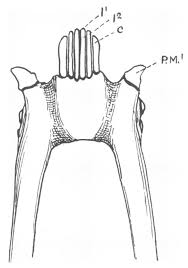
heterodent, meaning they have multiple tooth morphologies. Their dental formula
is 2.1.3.3, 2 incisors, 1 canine, 3, premolars, and 3 premolars.The lemur’s teeth are perfect for grooming themselves due to
the six comb-like teeth that stick straight out from their jaws. They also use
their comb teeth to pick out seeds from the fruit

.
Spider Monkey
The spider monkey is a new world monkey that lives in the
forested regains of central and South America. Spider Monkey’s prefer to live
in tropical rain forests in the canopies high above the ground, making them
arboreal herbivorous, meaning they tend to only eat fruits, leaves, and
nuts. The spider monkey’s dental formula
is 2.1.3.3; the dentition pater is 2 incisors, 1 canine, 3 premolars, and 3
premolars. Spider monkeys as some other monkeys are fruit eaters; they use
their incisors to pick fruits off trees.
Baboons
Baboons live in east Africa, Kenya, and Tanzania. They’re
very adaptable animals, they can survive without water for a couple days, or
lick the dew off there fur if needed water. Baboons have powerful jaws and
teeth’s and the dental formal is similar as the gibbons and chimps. The dental
formula is 2.1.2.3; the dentition pattern is 2, incisors, 1 canine, 2
premolars, and 3 molars. Baboons are omnivorous, meaning that he eats both
plants and small animals meanly due to its habitat. The baboons use their
central incisors for cutting food, their premolars and molar for grinding and
tearing of the food they are consuming and the canines is also used for tearing
their food.
Gibbons
Gibbons are found in Southeast Asia. They live in tropical
and subtropical rain forests. Gibbons have been considered endangered by many
countries. They are omnivores, meaning that they eat both meant and fruits.
Gibbons have shortened jaws with long canine teeth. Their dental formula is
2.1.2.3; they have 2 incisors, 1 canine, 2 premolars, and 3 molars. Gibbons
lean towards eating fruits, which due to their habitat is everywhere. The structure of their teeth has been adapted
due to their environment, to help them eat their food.
Chimpanzee
Chimpanzees are found in western and central Africa.
Chimpanzees can live in dry savannas, evergreen rainforests, and swamp forests
making them very adaptable to their surroundings.
The Chimpanzee, gibbons, and baboons share similar dental
formulas. . The dental formula is 2.1.2.3; the dentition pattern is 2,
incisors, 1 canine, 2 premolars, and 3 molars. Chimpanzees have 32 teeth; 16 on
the upper jaw and 16 on the lower jaw. They used their molars to grind on leaves
and fruits. Chimpanzees diet consists of meant and plants since they are omnivorous,
making their teeth adaptable to anything.
When studying these primates dentition patterns, we can determine that the primates environment and type of food makes an effect on their dental structure. We see that Spider Monkeys and lemurs are new world monkeys and share the same dental formula 2.1.2.3. Both of them habitat in similar environment and eat similar food as well, forming their dentition corresponding to their natural environment. The three left also share common dental formula 2.1.2.3 making them old world monkeys. Their dental structure is similar due to the type of food they consume.


